AI & Tools
ChatGPT Prompts for Your Next Launch
Learn the 5-part framework for launch prompts, plus 40+ ready-to-use ChatGPT prompts organized by pre-launch, launch day, and post-launch stages.


Decktopus Content Team
What Are ChatGPT Launch Prompts?
ChatGPT launch prompts are structured instructions that tell an AI model exactly what launch content to produce, for whom, in what tone, and with what constraints. A well-built prompt turns ChatGPT from a generic writing assistant into a launch-day copywriter, PR strategist, and social manager rolled into one. The main benefit is speed: a launch that used to take a team two weeks of writing can now ship in two days.
ChatGPT has grown into one of the most widely used AI tools in business, with hundreds of millions of weekly users as of 2025. Launch teams have quickly become one of its fastest-adopting segments, using it to write hero copy, Product Hunt posts, launch emails, PR outreach, and pitch decks in a fraction of the time. According to research on prompt engineering, structured prompts with role, context, task, format, and constraints produce output rated 40 to 60% higher quality than generic one-liners.
For broader guidance on AI content creation, see our guides on the best AI content generators, AI writer, and how to optimize your ChatGPT content.
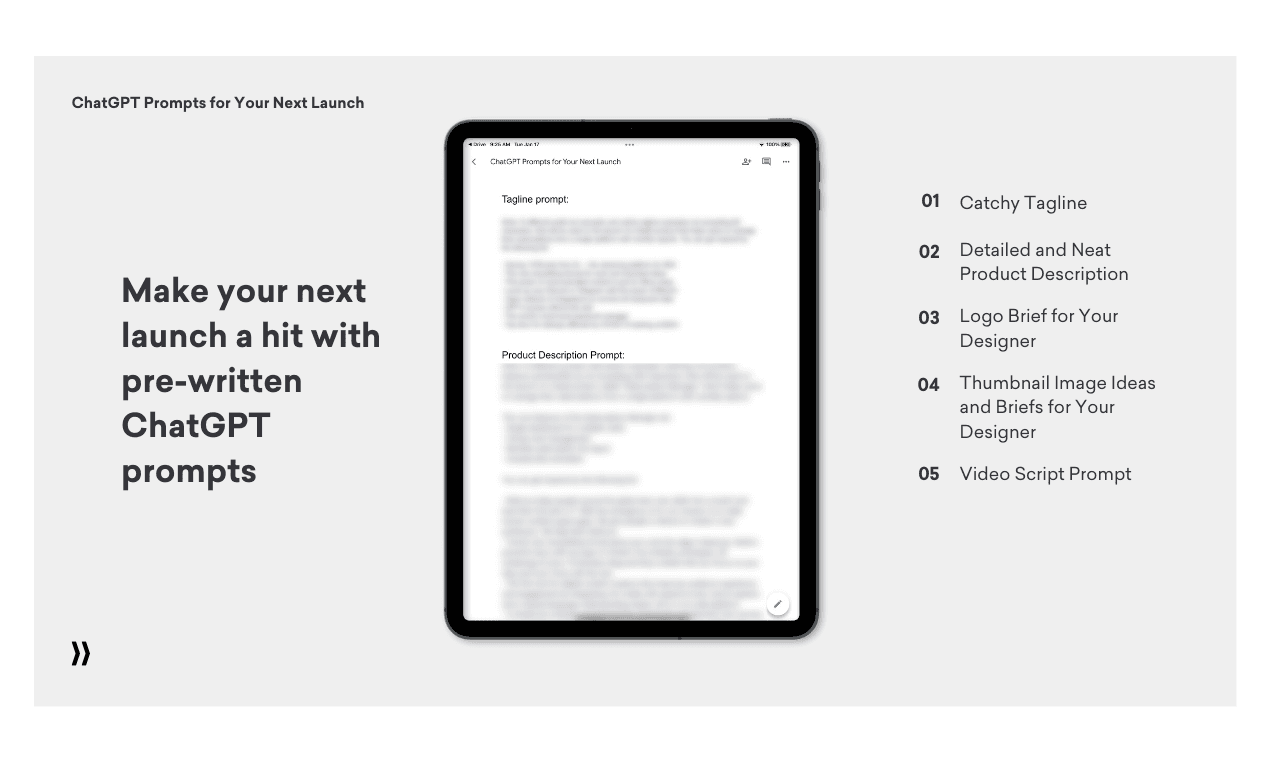
The 5-Part Launch Prompt Framework
Every effective launch prompt hits these 5 elements. Skip any of them and quality drops.
[[EMBED:PGRpdiBzdHlsZT0ib3ZlcmZsb3cteDphdXRvO21hcmdpbjoyMHB4IDAiPjx0YWJsZSBzdHlsZT0id2lkdGg6MTAwJTtib3JkZXItY29sbGFwc2U6Y29sbGFwc2U7Zm9udC1zaXplOjE1cHg7bWFyZ2luOjhweCAwIj48dGggc3R5bGU9ImJvcmRlcjoxcHggc29saWQgI2UzZTZlYTtwYWRkaW5nOjEwcHggMTRweDt0ZXh0LWFsaWduOmxlZnQ7YmFja2dyb3VuZDojZjRmNmY4O2ZvbnQtd2VpZ2h0OjYwMCI+PHRyPjx0aCBzdHlsZT0iYm9yZGVyOjFweCBzb2xpZCAjZTNlNmVhO3BhZGRpbmc6MTBweCAxNHB4O3RleHQtYWxpZ246bGVmdDtiYWNrZ3JvdW5kOiNmNGY2Zjg7Zm9udC13ZWlnaHQ6NjAwIj5FbGVtZW50PC90aD48dGggc3R5bGU9ImJvcmRlcjoxcHggc29saWQgI2UzZTZlYTtwYWRkaW5nOjEwcHggMTRweDt0ZXh0LWFsaWduOmxlZnQ7YmFja2dyb3VuZDojZjRmNmY4O2ZvbnQtd2VpZ2h0OjYwMCI+V2hhdCBJdCBDb3ZlcnM8L3RoPjwvdHI+PC90aGVhZD48dGJvZHk+PHRyPjx0ZCBzdHlsZT0iYm9yZGVyOjFweCBzb2xpZCAjZTNlNmVhO3BhZGRpbmc6MTBweCAxNHB4O3RleHQtYWxpZ246bGVmdDt2ZXJ0aWNhbC1hbGlnbjp0b3AiPlJvbGU8L3RkPjx0ZCBzdHlsZT0iYm9yZGVyOjFweCBzb2xpZCAjZTNlNmVhO3BhZGRpbmc6MTBweCAxNHB4O3RleHQtYWxpZ246bGVmdDt2ZXJ0aWNhbC1hbGlnbjp0b3AiPldobyBDaGF0R1BUIHNob3VsZCBhY3QgYXMgKGNvcHl3cml0ZXIsIFBSIGV4cGVydCwgZm91bmRlciwgY29tbXVuaXR5IG1hbmFnZXIpPC90ZD48L3RyPjx0cj48dGQgc3R5bGU9ImJvcmRlcjoxcHggc29saWQgI2UzZTZlYTtwYWRkaW5nOjEwcHggMTRweDt0ZXh0LWFsaWduOmxlZnQ7dmVydGljYWwtYWxpZ246dG9wIj5Db250ZXh0PC90ZD48dGQgc3R5bGU9ImJvcmRlcjoxcHggc29saWQgI2UzZTZlYTtwYWRkaW5nOjEwcHggMTRweDt0ZXh0LWFsaWduOmxlZnQ7dmVydGljYWwtYWxpZ246dG9wIj5Qcm9kdWN0LCBhdWRpZW5jZSwgbGF1bmNoIHN0YWdlLCBwb3NpdGlvbmluZywgYW5kIHRvbmU8L3RkPjwvdHI+PHRyPjx0ZCBzdHlsZT0iYm9yZGVyOjFweCBzb2xpZCAjZTNlNmVhO3BhZGRpbmc6MTBweCAxNHB4O3RleHQtYWxpZ246bGVmdDt2ZXJ0aWNhbC1hbGlnbjp0b3AiPlRhc2s8L3RkPjx0ZCBzdHlsZT0iYm9yZGVyOjFweCBzb2xpZCAjZTNlNmVhO3BhZGRpbmc6MTBweCAxNHB4O3RleHQtYWxpZ246bGVmdDt2ZXJ0aWNhbC1hbGlnbjp0b3AiPlRoZSBzcGVjaWZpYyBwaWVjZSBvZiBjb250ZW50IHRvIGdlbmVyYXRlPC90ZD48L3RyPjx0cj48dGQgc3R5bGU9ImJvcmRlcjoxcHggc29saWQgI2UzZTZlYTtwYWRkaW5nOjEwcHggMTRweDt0ZXh0LWFsaWduOmxlZnQ7dmVydGljYWwtYWxpZ246dG9wIj5Gb3JtYXQ8L3RkPjx0ZCBzdHlsZT0iYm9yZGVyOjFweCBzb2xpZCAjZTNlNmVhO3BhZGRpbmc6MTBweCAxNHB4O3RleHQtYWxpZ246bGVmdDt2ZXJ0aWNhbC1hbGlnbjp0b3AiPkxlbmd0aCwgc3RydWN0dXJlLCBjaGFubmVsLCBhbmQgdG9uZTwvdGQ+PC90cj48dHI+PHRkIHN0eWxlPSJib3JkZXI6MXB4IHNvbGlkICNlM2U2ZWE7cGFkZGluZzoxMHB4IDE0cHg7dGV4dC1hbGlnbjpsZWZ0O3ZlcnRpY2FsLWFsaWduOnRvcCI+Q29uc3RyYWludHM8L3RkPjx0ZCBzdHlsZT0iYm9yZGVyOjFweCBzb2xpZCAjZTNlNmVhO3BhZGRpbmc6MTBweCAxNHB4O3RleHQtYWxpZ246bGVmdDt2ZXJ0aWNhbC1hbGlnbjp0b3AiPk11c3QtaW5jbHVkZXMsIG11c3QtZXhjbHVkZXMsIGJyYW5kIHJ1bGVzLCBhbmQgZGlzYWxsb3dlZCBwaHJhc2VzPC90ZD48L3RyPjwvdGJvZHk+PC90YWJsZT48L2Rpdj4=]]
Template you can copy:
Act as a [Role]. I’m launching [Product] for [Audience] with the positioning [Positioning]. Write [Task] that fits [Channel/Format]. Keep it [Length/Tone]. Include [Must-haves]. Avoid [Must-nots].
The remaining 40+ prompts in this article all use this framework.
[[EMBED:PGRpdiBzdHlsZT0ib3ZlcmZsb3cteDphdXRvO21hcmdpbjoyMHB4IDAiPjx0YWJsZSBzdHlsZT0id2lkdGg6MTAwJTtib3JkZXItY29sbGFwc2U6Y29sbGFwc2U7Zm9udC1zaXplOjE1cHg7bWFyZ2luOjhweCAwIj48dGggc3R5bGU9ImJvcmRlcjoxcHggc29saWQgI2UzZTZlYTtwYWRkaW5nOjEwcHggMTRweDt0ZXh0LWFsaWduOmxlZnQ7YmFja2dyb3VuZDojZjRmNmY4O2ZvbnQtd2VpZ2h0OjYwMCI+PHRyPjx0aCBzdHlsZT0iYm9yZGVyOjFweCBzb2xpZCAjZTNlNmVhO3BhZGRpbmc6MTBweCAxNHB4O3RleHQtYWxpZ246bGVmdDtiYWNrZ3JvdW5kOiNmNGY2Zjg7Zm9udC13ZWlnaHQ6NjAwIj5HZW5lcmljIFByb21wdDwvdGg+PHRoIHN0eWxlPSJib3JkZXI6MXB4IHNvbGlkICNlM2U2ZWE7cGFkZGluZzoxMHB4IDE0cHg7dGV4dC1hbGlnbjpsZWZ0O2JhY2tncm91bmQ6I2Y0ZjZmODtmb250LXdlaWdodDo2MDAiPkxhdW5jaC1PcHRpbWl6ZWQgUHJvbXB0PC90aD48L3RyPjwvdGhlYWQ+PHRib2R5Pjx0cj48dGQgc3R5bGU9ImJvcmRlcjoxcHggc29saWQgI2UzZTZlYTtwYWRkaW5nOjEwcHggMTRweDt0ZXh0LWFsaWduOmxlZnQ7dmVydGljYWwtYWxpZ246dG9wIj4gIldyaXRlIGEgbGF1bmNoIGVtYWlsLiIgPC90ZD48dGQgc3R5bGU9ImJvcmRlcjoxcHggc29saWQgI2UzZTZlYTtwYWRkaW5nOjEwcHggMTRweDt0ZXh0LWFsaWduOmxlZnQ7dmVydGljYWwtYWxpZ246dG9wIj4gIkFjdCBhcyBhIEIyQiBTYWFTIGxhdW5jaCBjb3B5d3JpdGVyLiBJJ20gbGF1bmNoaW5nIGFuIEFJIGV4cGVuc2UtcmVwb3J0IHRvb2wgZm9yIGZpbmFuY2UgdGVhbXMgYXQgbWlkLW1hcmtldCBjb21wYW5pZXMuIFdyaXRlIGEgMTUwLXdvcmQgbGF1bmNoIGVtYWlsIHRoYXQgb3BlbnMgd2l0aCBhIHNwZWNpZmljIHBhaW4gcG9pbnQsIHN0YXRlcyB0aGUgcHJvZHVjdCBiZW5lZml0IGluIG9uZSBzZW50ZW5jZSwgaW5jbHVkZXMgb25lIHNvY2lhbCBwcm9vZiBsaW5lLCBhbmQgZW5kcyB3aXRoIGEgc29mdCBDVEEgdG8gYm9vayBhIGRlbW8uIEF2b2lkIGJ1enp3b3JkcyBsaWtlIDxlbT5yZXZvbHV0aW9uYXJ5PC9lbT4gYW5kIDxlbT5nYW1lLWNoYW5naW5nPC9lbT4uIiA8L3RkPjwvdHI+PHRyPjx0ZCBzdHlsZT0iYm9yZGVyOjFweCBzb2xpZCAjZTNlNmVhO3BhZGRpbmc6MTBweCAxNHB4O3RleHQtYWxpZ246bGVmdDt2ZXJ0aWNhbC1hbGlnbjp0b3AiPiAiR2l2ZSBtZSBhIFByb2R1Y3QgSHVudCBwb3N0LiIgPC90ZD48dGQgc3R5bGU9ImJvcmRlcjoxcHggc29saWQgI2UzZTZlYTtwYWRkaW5nOjEwcHggMTRweDt0ZXh0LWFsaWduOmxlZnQ7dmVydGljYWwtYWxpZ246dG9wIj4gIkFjdCBhcyBhIFByb2R1Y3QgSHVudCBjb3B5d3JpdGVyLiBJJ20gbGF1bmNoaW5nIGEgQ2hyb21lIGV4dGVuc2lvbiB0aGF0IHN1bW1hcml6ZXMgbG9uZyBQREZzIGluIHVuZGVyIDYwIHNlY29uZHMuIFdyaXRlIGEgUHJvZHVjdCBIdW50IHRhZ2xpbmUgKG1heGltdW0gNjAgY2hhcmFjdGVycyksIGEgb25lLXBhcmFncmFwaCBkZXNjcmlwdGlvbiAobWF4aW11bSAyNjAgY2hhcmFjdGVycyksIGFuZCBhIG1ha2VyIGNvbW1lbnQgZXhwbGFpbmluZyB3aHkgSSBidWlsdCB0aGlzLiBVc2UgYSBmb3VuZGVyIHRvbmUgYW5kIGluY2x1ZGUgb25lIHNwZWNpZmljIHVzZSBjYXNlLiIgPC90ZD48L3RyPjwvdGJvZHk+PC90YWJsZT48L2Rpdj4=]]
The difference is time-to-usable output. Generic prompts produce first drafts you have to rewrite. Framework prompts produce content you can ship after light edits.
For more on writing that ranks and reads well, see best AI content generators.
Pre-Launch Prompts (4-8 Weeks Before)
Everything you build before launch day: positioning, landing pages, waitlist copy, warm-up content, and internal messaging.
1. Positioning Statement Prompt
Act as a positioning strategist. My product is [product] for [audience]. It solves [problem] by [approach]. Write 3 positioning statements in the format: “For [audience] who [need], [product] is the [category] that [key benefit].” Make each one under 30 words.
2. One-Sentence Value Proposition
Act as a landing page copywriter. Write 5 one-sentence value propositions for [product], a [category] built for [audience]. Each should lead with the outcome the customer gets, not the feature. Max 15 words each.
3. Landing Page Hero Copy
Act as a SaaS landing page copywriter. Write hero copy for [product]. Include: headline (max 10 words), subheadline (max 25 words), and CTA button text (2-4 words). The tone should be [confident/friendly/authoritative]. Audience: [audience]. Main pain point: [pain].
4. Waitlist Landing Page Copy
Act as a growth marketer. Write full waitlist landing page copy for [product] launching in [month]. Include: hero headline, subhead, 3 benefit bullets, one social proof line, and email capture CTA. Tone: energetic, specific, no buzzwords. Word count: under 250 total.
5. Feature Announcement Blog Post
Act as a product marketer. Write a 700-word blog post announcing [feature] for [product]. Structure: hook (real user pain), what the feature does, how it works (3-step walkthrough), one customer quote placeholder, CTA. Include one comparison to how users solved the problem before. Tone: helpful, specific.
For more on positioning, see our guide on effective marketing strategies and market analysis.
6. Elevator Pitch for Launch Meetings
Act as a founder pitching to investors. Write a 60-second elevator pitch for [product], a [category] for [audience]. Include: hook, problem, solution, one traction stat, ask. Style: conversational, confident, no jargon.
See our elevator pitch examples for more.
7. Content Calendar for 30-Day Runway
Act as a content strategist. Build a 30-day pre-launch content calendar for [product]. Include: post format (blog, LinkedIn, X, Instagram, email), topic, hook idea, and target audience segment for each day. Focus on building anticipation and educating the market on [problem]. Output as a table.
See our content calendar template for the follow-up structure.
8. Product Hunt Teaser Post
Act as a Product Hunt community manager. Write a teaser post for [product] launching in [week]. 100 words max. Include: what it does in one sentence, who it’s for, why now, and a soft ask for upcoming hunters to follow. Founder voice. Avoid over-hype.
9. Email Nurture Sequence (5 emails)
Act as a lifecycle marketer. Write a 5-email nurture sequence for waitlist subscribers of [product]. Space: 3 days apart. Email topics: (1) welcome + why we’re building this, (2) the problem in detail, (3) sneak peek of the product, (4) case study or beta feedback, (5) launch day heads-up. Each email: under 150 words. Founder-signed.
For deeper email guidance, see our email marketing guide.
10. Investor Pre-Launch Update
Act as a startup founder writing to investors. Write a pre-launch update email covering: launch date, positioning summary, waitlist signups, top press or partner conversations, key risks, and 2 asks. Under 300 words. Concrete, honest tone.
Launch Day Prompts
Launch day is a coordination sprint. These prompts cover every asset you need in the first 24 hours.
11. Product Hunt Launch Post
Act as a Product Hunt copywriter. Write a full launch post for [product]. Include: name tagline (max 60 chars), full description (max 260 chars), maker comment (200-300 words explaining why you built it, what problem it solves, and what’s next). Founder voice. Specific, not generic.
12. Product Hunt Maker Comment
Act as a startup founder. Write a Product Hunt maker comment introducing [product]. Include: why we built this, who it’s for, what’s different about our approach, one concrete example of how someone would use it in 60 seconds. Voice: honest and confident. 200 words max.
13. Launch Day Tweet Thread
Act as a SaaS founder writing a launch tweet thread. Product: [product] for [audience]. Structure: (1) hook tweet with headline claim, (2) the problem, (3) how we solved it, (4-6) key features with visuals prompts, (7) traction so far, (8) CTA to try it. Each tweet: under 280 chars. Voice: confident, not salesy.
14. LinkedIn Launch Announcement
Act as a B2B founder posting on LinkedIn. Write a launch announcement for [product]. Structure: hook line (1 sentence), the story of why we built it (100 words), what it does (50 words), 3 key benefits (as bullets), CTA to try or share. Total: 300 words max. Voice: personal, specific.
15. Launch Email to Full List
Act as a lifecycle marketer. Write a launch day email to our full email list announcing [product]. Include: 1-line hook, product description, 3 benefits, one visual placeholder, primary CTA (try it), secondary CTA (share). Under 200 words. Tone: excited but not desperate.
16. Press Release
Act as a PR writer. Write a 400-word press release announcing [product] by [company]. Include: dateline, headline (60 chars max), lead paragraph (who/what/where/when/why), 2 supporting paragraphs, quote from founder, quote from customer, boilerplate about the company, media contact. Formal tone.
17. Press Pitch Email to Journalists
Act as a startup PR lead. Write a 120-word cold email pitching [product] to a tech journalist at [publication]. Subject line: under 8 words. Body: hook that ties to a trend the journalist covers, one-sentence product description, one traction stat, offer of exclusive founder interview. No attachments, no marketing fluff.
18. Community Slack/Discord Launch Post
Act as a community manager. Write a launch day announcement for [product] in our Slack/Discord community. Include: hook, what it is, 3 benefits, ask (try it, share feedback), thank-you to early testers. 150 words max. Voice: personal, humble.
19. Sales Team Launch Enablement Email
Act as a head of sales enablement. Write an internal email to the sales team announcing [product] launch. Include: what’s launching, top 3 talking points, target ICP, competitive positioning against [competitor], and 3 objection responses. Format: sections with headers. Under 400 words.
For deeper sales pitch guidance, see sales pitch and how to prepare a sales proposal.
20. Founder Launch Post (Personal LinkedIn/X)
Act as a founder writing a personal social post about launching [product]. Voice: reflective, honest. Include: the moment that led to building this, one thing that almost broke us, what we shipped today, gratitude to a specific person or group. 250 words max. No hashtags.
Post-Launch Prompts (Weeks 1-4)
The launch isn’t over on day 1. These prompts cover follow-up content, feedback synthesis, and momentum-keeping content.
21. Launch Day Recap Post
Act as a founder writing a launch recap post. Include: launch day stats (users, signups, PH rank), one unexpected moment, one lesson learned, thank-you to the community, what’s next. 300 words. Voice: honest, grateful.
22. Customer Testimonial Request Email
Act as a customer success lead. Write a 100-word email asking new customers of [product] for a short testimonial or case study. Include: what specifically we’d love them to share (a problem solved, a result), the format options (quote, video, full case study), and a small thank-you incentive. Warm, specific tone.
23. Case Study Outline
Act as a case study writer. Draft a case study outline for [customer] using [product]. Structure: customer background (2 sentences), the problem they had (2 sentences), the solution and how they implemented it, specific results with numbers, one memorable quote, CTA. Total length target: 600 words.
24. Social Proof Content
Act as a social media manager. Turn this customer quote into 3 versions: (1) a short LinkedIn post (under 100 words), (2) a Twitter/X tweet (under 280 chars), (3) an Instagram carousel outline (5 slides). Original quote: “[quote here]”. Add appropriate credit and CTA.
25. User Feedback Synthesis Prompt
Act as a product researcher. I’ll paste 20 user feedback comments from our launch. Categorize them by theme (feature requests, bugs, praise, confusion, churn signals). For each theme: count the mentions, summarize the pattern in one line, and suggest one action item. Output as a table.
26. Weekly Launch Metrics Report
Act as a growth analyst. Write a weekly launch metrics update. Include: signups, activated users, key conversion rate, retention day 7, top acquisition channel, one lesson, one next action. Format: bulleted sections. Under 200 words. Concrete numbers only.
27. Retention Email for Inactive Users
Act as a lifecycle marketer. Write a re-engagement email for users who signed up during launch but haven’t returned in 7 days. Include: one-line hook that names the problem they signed up to solve, one clear next step (a specific use case), a link to a tutorial or Loom, one CTA. Under 100 words. Warm, not desperate.
28. Investor Post-Launch Update
Act as a startup founder writing to investors. Post-launch update. Include: launch day results (numbers), top press or community wins, retention/activation early signals, 2 things not working, next 30-day priorities, 1 ask. Under 400 words. Honest, no spin.
For more on investor communication, see how to make the best startup pitch and pitch deck examples.
29. Blog Post: “How [Company] Uses [Product]”
Act as a content marketer. Write a 700-word customer story blog post about how [customer] uses [product]. Structure: intro with their challenge, background on their team, what changed after implementing us, results with numbers, quote, closing CTA. Voice: their voice, not ours.
30. Cold Outbound Email Referencing the Launch
Act as an SDR at [company]. Write a 90-word cold outbound email to [ICP]. Reference our recent launch as social proof (one line). Focus 80% on the recipient’s specific pain point. End with a soft CTA for a 15-min chat. Subject line under 6 words.
For related content, see how to sell an idea and marketing pitch.
31. Community Q&A / AMA Prep
Act as a founder preparing for a community AMA. Given [product] and [launch stats], draft the top 15 questions people are likely to ask. For each: write a 2-3 sentence answer in founder voice. Include the honest hard ones (competitors, pricing, roadmap risks). Output as a numbered list.
32. Product Hunt Thank-You Post
Act as a founder writing a thank-you post after a Product Hunt launch. Include: how we ranked, thank-you to specific groups (hunters, users, team), one honest reflection on the day, what’s next. 200 words max. Voice: humble, warm.
33. Podcast Pitch Email
Act as a startup founder. Write a 100-word pitch to a podcast host at [show]. Reference one specific episode of theirs. Explain in one line why I’d be a good guest given the launch of [product]. Suggest one story angle they haven’t covered. End with dates I’m available.
34. Repurpose Launch Content Prompt
Act as a content repurposer. I’m giving you our launch day LinkedIn post. Turn it into: (1) a 5-tweet thread, (2) an Instagram carousel outline (7 slides), (3) a 60-second video script, (4) a short blog intro, (5) an email teaser. Keep the same core message. Original post: [paste here].
For more on distribution, see 11 marketing tips for startups and B2B marketing.
35. Follow-Up Blog: Lessons From Our Launch
Act as a founder writing a lessons-learned post about our launch. Structure: hook, top 3 things that worked, top 3 things that didn’t, one big surprise, one recommendation for other founders. 800 words. Honest, specific numbers, no ego.
How to Build Your Launch Deck with Decktopus AI
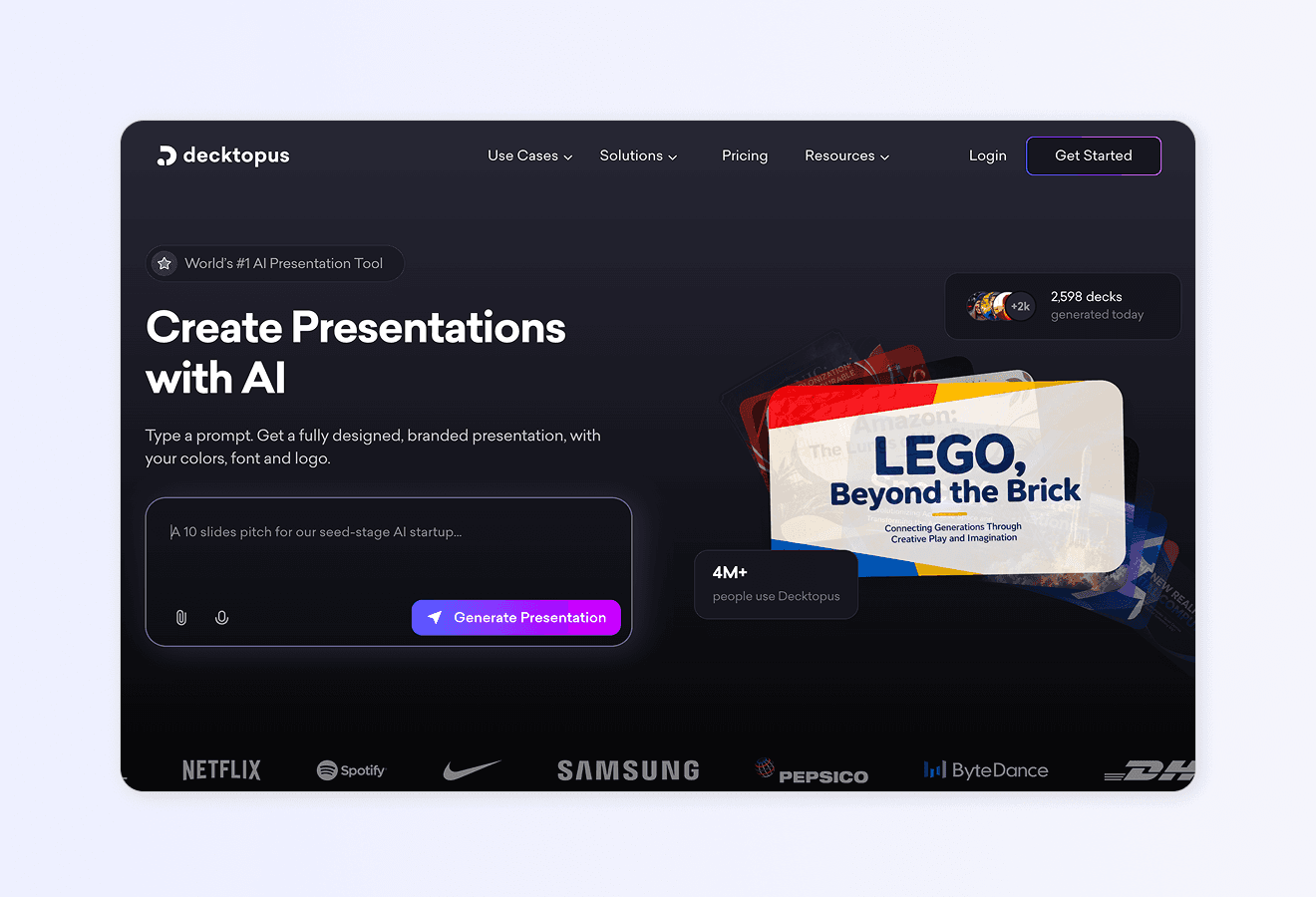
Launch content is spoken and written. Your launch deck is what backs it all up. Decktopus AI generates a full launch deck from a short description in minutes.
1. Describe your topic. Type something like “Product Hunt launch deck for an AI expense-report tool targeting finance teams.” Or upload your one-pager, positioning doc, or launch notes as a supporting file. If you already have an older deck, Decktopus AI’s Beautify feature can redesign it or use it as a source.
2. Choose your style. Pick a brand, reuse a saved look, or start fresh with AI. Decktopus AI will ask how you want your presentation to look. You can apply a saved brand, import your brand directly from your company website URL (which pulls in your logo, colors, and fonts), or let AI generate a style from scratch.
3. Review the outline. Decktopus AI generates a slide-by-slide structure covering intro, problem, solution, market, product demo, traction, launch results, roadmap, and ask. Adjust before the full deck is built.
4. Refine with Edit with AI. Click Edit with AI and type instructions like “add a comparison table vs. the top 2 competitors” or “make the traction slide more visual.” All edits are tracked with unlimited version history.
5. Export or share. Download as PDF, PPT, or PNG. Share via live link. Any updates you make afterward automatically appear at the same URL, so investors, press, and partners always see the latest version. Or present directly.
You can also use the Loop AI Delivery Coach during rehearsal for real-time feedback on pacing, filler words, and clarity before your launch talk or investor meeting.
For broader guidance, see the best pitch deck generators for founders, our roundup of the best AI presentation tools, and our guide on how to do a presentation.
Ready to build a launch deck that ships in under an hour? Get started with Decktopus AI.
Frequently Asked Questions
What is a launch prompt for ChatGPT?
A launch prompt is a structured instruction that tells ChatGPT what launch content to produce (like a press release, launch email, or Product Hunt post), for what audience, in what tone, and with what constraints. Good launch prompts follow the 5-part framework: role, context, task, format, constraints.
How do I write a good ChatGPT prompt for a product launch?
Give ChatGPT four things: (1) the role you want it to play (copywriter, PR lead, community manager), (2) the context of your product and audience, (3) the specific task, (4) the format and length, and (5) the constraints and brand rules. This structure produces 40 to 60% higher-quality output than generic prompts.
What ChatGPT prompt works best for a Product Hunt launch?
The maker comment is where launches often win or lose. Use: “Act as a Product Hunt copywriter. I’m launching [product] for [audience]. Write a 200-word maker comment covering why I built this, the problem it solves, one concrete use case, and what’s next. Voice: honest, specific, no hype.”
Can ChatGPT write my whole launch content?
It can produce strong first drafts across every channel: emails, social posts, press releases, sales scripts, blog posts, and pitch decks. Final polish, brand voice, and fact-checking still need a human. Treat ChatGPT as your fastest first-draft copywriter, not your final editor.
How many prompts do I need for a launch?
Most launches need about 20 to 35 pieces of unique content: waitlist copy, hero copy, launch email, Product Hunt post, tweet thread, LinkedIn post, press release, PR pitch, sales enablement email, community post, and a launch deck. That’s 20 to 35 targeted prompts, one per asset.
What tone should ChatGPT use for launch content?
Match the channel. Product Hunt: honest and founder-led. LinkedIn: personal and specific. Press release: formal. Twitter: punchy. Email: warm and direct. Always include the tone as part of the prompt.
How do I stop ChatGPT from sounding generic?
Include specific inputs: real audience names, real pain points, real numbers, and a “avoid” list of banned words (like “revolutionary,” “game-changing,” “seamless”). The more concrete the input, the less generic the output.
What tool should I use to build my launch deck?
Decktopus AI generates a full launch deck from a short description in minutes, with automatic brand import, Edit with AI, and Loop AI Delivery Coach for rehearsal. For more, see the best pitch deck generators for founders.
Related posts

8 AI Startups That Nailed Their Branding with a .AI Domain
Artificial intelligence continues to reshape the way we live and work. As an essential tool now powering a great number of industries, it’s no surprise that AI is driving a new era of search, too.
AI & Tools

5 Best AI Audio Enhancement Tools in 2026
AI Audio Enhancement Tools: Elevating Your Sound Experience
AI & Tools

AI Checker 2026: Unveiling the Latest in AI Detection Technology - ChatGPT, GPT-3, and Beyond
Explore the power of AI content checkers with our comprehensive guide. Discover how these intelligent tools enhance accuracy and efficiency in various applications. Stay ahead in 2026 with insights on the latest advancements and practical tips for leveraging AI checkers and chatgpt detectors effectively.
AI & Tools